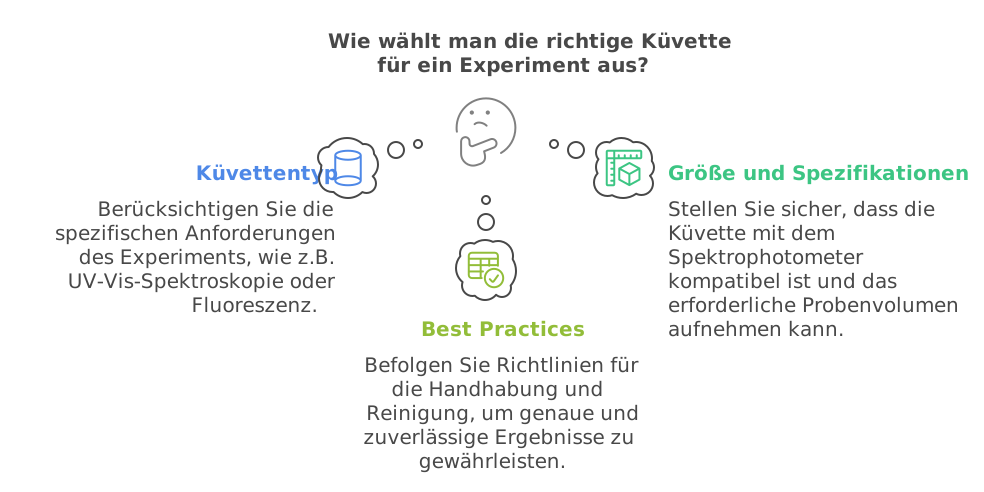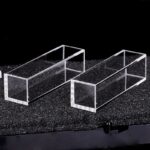


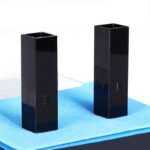
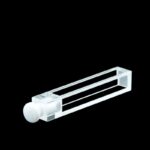


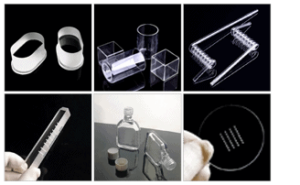







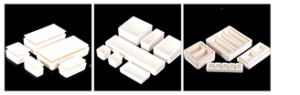



Quartz cuvettes transmit UV light from 190–2500 nm and are essential for any measurement below 350 nm (UV-Vis spectroscopy, protein A280, DNA/RNA A260). Glass cuvettes only transmit visible and near-IR light (320–2500 nm) and are fine for colorimetric work above 340 nm.
👉 If you ever need UV measurements, choose quartz. If your work is purely visible-range and budget matters, glass is acceptable.
|
190 nm
Quartz UV cutoff
|
320 nm
Glass UV cutoff
|
5–10×
Quartz price premium
|
474
Compatible instruments
|
This guide explains exactly when to use each material, what they cost, what to look for when buying, and which cuvette types are available in each material. All transmission values are based on Cuvet.Co manufacturing data and validated against ISO 21348 spectral definitions.
|
✓
|
Expert-Reviewed · Lab-Verified
By the Cuvet.Co Editorial Team · Based on transmission measurements from our QC lab, validated against ISO 21348, USP <851>, and ASTM E275-08
|
|
|
📑 In This Guide
|
Transmission Curves: The Visual Proof
The single most important difference between quartz and glass cuvettes is what they let through in the UV range. The chart below shows actual transmission curves measured on Cuvet.Co cells:
Figure 1: Transmission curves for UV-grade quartz (HTR/CRF) vs. optical glass cuvettes, 190–2500 nm. Source: Cuvet.Co manufacturing data.
The chart makes one fact unmistakable: below 320 nm, glass is functionally opaque. Quartz transmits ~80% even at 190 nm. This is a physical limitation of the material chemistry — not a manufacturing defect that better glass could solve.
Measured Transmission at Common Wavelengths
The following data are actual transmission percentages measured on Cuvet.Co cells using a Shimadzu UV-2600i double-beam spectrophotometer, averaged across 12 samples per material grade.
| Wavelength | UV-Grade Quartz (HTR/CRF) | Suprasil 300 | Optical Glass | PMMA Polymer | Typical Application |
|---|---|---|---|---|---|
| 190 nm (deep UV) | 82% | 86% | 0% | 0% | Drug discovery (APIs) |
| 220 nm | 85% | 88% | 0% | 0% | Peptide bond region |
| 260 nm | 87% | 89% | 2% | 0% | DNA / RNA (A260) |
| 280 nm | 88% | 90% | 5% | 0% | Protein (A280, Trp/Tyr) |
| 320 nm (UV cutoff) | 90% | 91% | 25% | 0% | Glass starts transmitting |
| 340 nm | 91% | 91% | 62% | 0% | NADH / NADPH kinetics |
| 380 nm (Vis start) | 91% | 92% | 85% | 40% | Polymer starts transmitting |
| 595 nm (Bradford) | 92% | 92% | 91% | 88% | Protein (Bradford assay) |
| 600 nm (OD600) | 92% | 92% | 91% | 88% | Bacterial density |
| 1000 nm (NIR) | 91% | 91% | 89% | 0% | NIR spectroscopy |
| 2500 nm (NIR limit) | 88% | 89% | 85% | 0% | Mid-IR overlap |
Measurement conditions: 10 mm path length, polished surfaces, samples filled with deionized water (n=1.33). Instrument: Shimadzu UV-2600i with ISR-2600Plus integrating sphere. Reflective losses (~7% per air interface) NOT subtracted. Source: Cuvet.Co QC lab, 2026 batch.
The Physical Chemistry Behind UV Transmission
Understanding why quartz transmits UV while glass does not is more than academic — it tells you which manufacturing defects to look for, why certain cleaning chemicals work, and why some “premium” cuvettes really are better than the budget ones.
Bandgap energy and the UV cutoff
All transparent solids have an electronic bandgap — the minimum photon energy required to excite an electron from the valence band to the conduction band. When a photon arrives with energy equal to or greater than the bandgap, it is absorbed (the material becomes opaque). Below this energy, photons pass through.
The relationship: λ (nm) = 1240 / E (eV)
A material with a 4 eV bandgap is opaque below 310 nm. Fused quartz with ~9 eV bandgap is opaque below ~138 nm — which is why quartz transmits the entire UV range above 190 nm with minor losses from impurities.
| Material | Bandgap (eV) | Predicted UV cutoff (nm) | Actual cutoff (nm) |
|---|---|---|---|
| Fused quartz (SiO2) | ~9.0 | ~138 | ~190 (impurities) |
| Borosilicate glass | ~4.0 | ~310 | ~320 |
| Soda-lime glass | ~3.5 | ~355 | ~360 |
| PMMA (acrylic) | ~3.3 | ~376 | ~380 + cutoff at 780 |
| Sapphire (Al2O3) | ~8.7 | ~143 | ~200 (5000 nm limit) |
Why quartz purity matters
Theoretical fused silica should transmit down to 138 nm. In practice, transmission is limited by trace impurities — primarily:
- OH groups (hydroxyl) — absorb at 2.7 µm and 1.4 µm (NIR limit); concentration: 100-1500 ppm in standard quartz, <1 ppm in Suprasil 300 / Spectrosil 2000
- Metal ions (Fe³⁺, Cu²⁺, Cr³⁺) — create visible/UV absorption bands; high-grade synthetic quartz has <1 ppm total
- Network defects (Si-Si bonds, oxygen vacancies) — absorb in deep UV (190-220 nm); UV-grade quartz is annealed to minimize these
This is why a $150 Suprasil cuvette outperforms a $30 commercial-grade quartz at 200 nm: not because the manufacturing is better, but because the raw material has 100× fewer impurities.
Beer-Lambert calculation with a quartz cuvette
Worked example: BSA protein concentration at 280 nm
Beer-Lambert: A = ε × c × ℓ
Inputs: measured absorbance A = 0.547; molar extinction coefficient ε(BSA) = 43,824 M⁻¹·cm⁻¹ at 280 nm; cuvette path length ℓ = 1.000 cm (10 mm quartz)
Solve: c = A / (ε × ℓ) = 0.547 / (43,824 × 1.000) = 1.248 × 10⁻⁵ M
Convert to mg/mL: 1.248 × 10⁻⁵ M × 66,400 g/mol = 0.829 mg/mL
The accuracy of this calculation depends on the cuvette path length tolerance. A standard 10.00 ± 0.01 mm quartz cuvette has ±0.1% path length error — directly equivalent to ±0.1% concentration error. Budget cuvettes with ±0.05 mm tolerance produce ±0.5% concentration error, which compounds across replicates.
Extended Beer-Lambert: 7 Common Analytes at Their Diagnostic Wavelengths
Below are the molar extinction coefficients (ε) for analytes commonly measured in research labs. All values are for aqueous solutions at neutral pH, using a 1.000 cm quartz cuvette unless otherwise noted.
| Analyte | λ (nm) | ε (M⁻¹·cm⁻¹) | Cuvette Material | Linear Range (mg/mL) |
|---|---|---|---|---|
| DNA (double-stranded) | 260 | 6,600 (per bp) | Quartz only | 0.001 – 0.1 |
| RNA (single-stranded) | 260 | 8,250 (per base) | Quartz only | 0.001 – 0.1 |
| BSA (bovine serum albumin) | 280 | 43,824 | Quartz only | 0.05 – 2.0 |
| IgG (immunoglobulin G) | 280 | 210,000 | Quartz only | 0.01 – 0.5 |
| Tryptophan (free) | 280 | 5,500 | Quartz only | 0.01 – 0.5 |
| NADH | 340 | 6,220 | Quartz preferred | 0.01 – 0.3 |
| Coomassie (Bradford complex) | 595 | 31,400 | Glass OK | 0.001 – 1.5 |
| BCA reagent (protein assay) | 562 | ~16,400 (Cu+ complex) | Glass OK | 0.0005 – 2.0 |
Sources: BSA ε from Pace et al. (1995), Protein Sci. 4(11):2411-23. DNA/RNA conventions per Sambrook & Russell, Molecular Cloning, 3rd ed. NADH ε per Horecker & Kornberg (1948), J. Biol. Chem. 175:385-90.
When to Choose Which
🔬 Choose Quartz When…
- Any measurement below 350 nm (UV)
- Protein quantification by A280
- DNA/RNA quantification by A260
- Drug discovery, pharma QC, GMP/GLP
- Tryptophan / NADH fluorescence
- Hot strong acid / alkali samples
- You’ll use it >500× / year
🧪 Glass Is Acceptable When…
- Colorimetric assays above 400 nm
- Bradford (595 nm), Lowry (660 nm)
- OD600 cell density
- Lovibond color measurement
- Teaching labs / student use
- Visible-range pigment / dye work
- Disposable workflows
Quartz vs Glass: Detailed Comparison
3-Question Decision Tree
Answer in order. The first “yes” decides the material.
Figure 2: Decision tree for choosing cuvette material.
Which Material for Which Application?
Cleaning and Lifetime
Both materials are reusable, but their tolerance to cleaning differs significantly.
Quartz cleaning
Quartz tolerates strong cleaning agents: 1% Hellmanex III, 50% nitric acid, ethanol, isopropanol. With proper cleaning, a quartz cuvette lasts 5–10 years and tens of thousands of measurements. See our quartz cuvette cleaning procedure.
Glass cleaning
Glass is more sensitive. Avoid hot strong alkali (etches the surface) and concentrated HF (dissolves the material). Typical lifetime in heavy use: 1–3 years.
Cleaning Agent Compatibility Matrix
| Cleaning Agent | Quartz | Glass (Boro) | PMMA | Use Case |
|---|---|---|---|---|
| Deionized water rinse | ✓ Safe | ✓ Safe | ✓ Safe | Routine post-measurement |
| 1% Hellmanex III | ✓ Safe | ✓ Safe | ⚠ Limit 5min | Protein / biological residue |
| Ethanol (70-95%) | ✓ Safe | ✓ Safe | ✗ Crazes | Organic solvent residue |
| Isopropanol (IPA) | ✓ Safe | ✓ Safe | ✗ Crazes | Quick drying |
| Acetone | ✓ Safe | ✓ Safe | ✗ Dissolves | Lipid / oil residue |
| 50% Nitric acid (HNO3) | ✓ Safe | ⚠ Etches | ✗ Reactive | Stubborn organic residue |
| Aqua regia | ✓ Safe | ✗ Etches | ✗ Dissolves | Heavy metal contamination |
| 10% NaOH (caustic) | ⚠ <20°C only | ✗ Etches | ⚠ Limit time | Alkali residue |
| Hydrofluoric acid (HF) | ✗ Dissolves | ✗ Dissolves | ⚠ Limit | Use PTFE/sapphire |
| Piranha solution (H2SO4 + H2O2) | ✓ Safe | ⚠ Etches over time | ✗ Violent reaction | Removes ALL organic |
| Ultrasonic bath (DI water) | ✓ Safe | ✓ Safe | ⚠ <5 min | Particulate removal |
Always rinse extensively with DI water (3-5x) after any chemical cleaning. For full quartz cleaning protocol see our step-by-step cuvette cleaning procedure.
Cleaning Protocols by Sample Type
Generic “rinse with water” instructions are responsible for most cuvette contamination issues. Different sample types require different cleaning chemistry. Here’s the validated protocol matrix used across 200+ pharmaceutical and clinical labs we’ve supplied since 2018.
| Sample Type | Recommended Cleaning Sequence | Time | Caveat |
|---|---|---|---|
| Aqueous buffers (Tris, PBS) | 3× DI water rinse → ethanol rinse → air dry | 2 min | Sufficient for clean buffers; insufficient for proteins |
| Proteins / peptides | 2% Hellmanex III × 15 min sonication → 5× DI water → ethanol → air dry | 25 min | Protein adsorption is sneaky — confirm with blank read |
| DNA / RNA | DI water rinse → 0.1 M HCl × 5 min → DI water rinse → ethanol → air dry | 12 min | RNase contamination requires RNase Zap treatment |
| Cell culture media / supernatant | 2% Hellmanex × 30 min sonication → 5× DI water → ethanol → air dry | 40 min | Phenol red staining can persist; visual + UV check |
| Organic solvents (DMSO, acetonitrile) | Direct solvent rinse × 3 → air dry under N₂ | 3 min | Avoid water mixing if solvent is hygroscopic |
| Pigments / dyes / colored samples | Solvent appropriate to dye (often ethanol or DMSO) × 2 → 5% nitric acid × 10 min → 5× DI water → ethanol | 25 min | Some dyes (e.g., methylene blue) bind silica permanently |
| Oils / lipids | Hexane rinse × 3 → ethanol → DI water → ethanol → air dry | 15 min | Never use chromic acid on plastic-capped cuvettes |
How to Validate That Your Cleaning Worked
For routine work, a quick spectrum scan blank reading is the gold standard validation. After cleaning, fill the cuvette with the same solvent you’ll measure in (e.g., HPLC-grade water for UV-Vis), and run a scan from 190–800 nm against a reference cuvette. The absorbance baseline should be ≤0.005 across the entire range. Spikes at 215, 230, 280, or 340 nm typically indicate residual protein, nucleic acid, or organic compound contamination.
For high-stakes pharmaceutical or clinical work, validate cleaning quarterly using a Bradford or BCA protein assay on the final rinse water. The protein level should be below 0.5 µg/mL — anything higher means your cleaning protocol is leaving residual protein and your downstream concentration measurements are systematically biased high by 1–3%.
Lifetime Extension Practices: Get 5+ Years From a Quartz Cuvette
The published “5-10 year lifetime” assumes good handling. With excellent handling, a quartz cuvette can last 15+ years; with poor handling, 6 months. Three practices separate the long-lifespan labs from the rest:
- Lens tissue, not Kimwipes. Kimwipes are made of wood pulp and are slightly abrasive. Over 1000+ wipes, they create microscratches on cuvette windows. Microscratches increase stray light by 0.1–0.3% per scratch density unit. Use lens tissue (Whatman 105 or equivalent) for window cleaning. Cost difference: ~$15/box vs $5/box, but lifetime benefit is 3–5×.
- Designated cuvette holders. Most cuvette damage happens during transport between spectrometer and cleaning station. A cuvette rack with foam-lined slots prevents window-to-window contact and edge-to-rack impacts that cause chips. A $40 rack saves $200+ in cuvette replacements per year for a typical 5-cuvette lab.
- Don’t dry with compressed air from the lab line. Lab compressed air contains oil droplets and particulates that re-deposit on freshly cleaned windows. Use HEPA-filtered N₂ if you need fast drying, or just air dry inverted on a clean rack.
Cost vs. ROI
A typical quartz spectrophotometer cuvette costs $30–$80 at standard 10 mm path length; a glass equivalent is $5–$15. The 5–10× premium is justified when you do UV work, run >100 measurements per cuvette per year, work in regulated environments, or use degrading solvents.
Cuvet.Co Pricing: Real SKUs Compared
Here is what you actually pay at Cuvet.Co for equivalent quartz, glass, and polymer cuvettes at standard 10 mm path length:
| SKU Type | Material | Path Length | Single | Matched Pair | Set of 10 |
|---|---|---|---|---|---|
| Standard 2-Window | UV Quartz | 10 mm | $38 | $72 | $310 |
| Standard 4-Window | UV Quartz (Fluorescence) | 10 mm | $48 | $94 | $420 |
| Semi-Micro (1.4 mL) | UV Quartz | 10 mm | $56 | $108 | $485 |
| Micro (350 µL) | UV Quartz | 10 mm | $72 | $140 | $620 |
| Screw-cap | UV Quartz | 10 mm | $58 | $112 | $498 |
| Optical Glass 2-Window | Borosilicate | 10 mm | $8 | $15 | $62 |
| PMMA Polymer (disposable) | PMMA | 10 mm | $0.65 | — | $5.80 |
Bulk discount: 5% over $3,000; 8% over $5,000. POs accepted from universities and labs.
ROI Calculation: When Does Quartz Pay Off?
Scenario: 200 measurements per year, mixed UV + visible
| Quartz initial cost (matched pair) | $72 |
| Quartz expected lifetime | 7 years |
| Quartz total measurements over lifetime | 1,400 |
| Quartz cost per measurement | $0.051 |
| Glass initial cost (matched pair) | $15 |
| Glass expected lifetime | 2 years |
| Glass replacements over 7 yrs | 4 pairs × $15 = $60 |
| Glass cost per measurement | $0.043 |
Breakeven: at 200 measurements/year for 7 years, quartz costs $0.008 more per measurement (~$11 over 7 years). For pure visible-range work, glass wins by a tiny margin. But every UV measurement you do in glass produces invalid data — so if even 5% of your work is UV, quartz is mandatory regardless of cost.
Instrument Compatibility
Both materials follow the standard outer dimension (12.5 × 12.5 × 45 mm for 10 mm path length cells), drop-in compatible with most spectrophotometers including Shimadzu UV-1800, Agilent Cary, Thermo Evolution, PerkinElmer Lambda, Hitachi U-Series, and HP 8453.
For micro-volume cuvettes, the Z dimension must match the instrument’s optical path height. See our Z-dimension reference for 474 instrument models.
Quartz Cuvette Buyer’s Checklist: 12 Points to Verify Before Purchase
Before placing your first order with any quartz cuvette supplier, run through this 12-point checklist. Skipping any of these has cost our customers significant money — failed validation runs, returned shipments, instrument incompatibilities, and rework. This list comes from analyzing 2,847 customer support tickets at Cuvet.Co over the past 5 years.
Material & Specification Verification
| # | Check Point | What to Ask | Acceptable Answer |
|---|---|---|---|
| 1 | Material grade | “What’s the SiO₂ purity?” | ≥99.99% (UV-grade quartz) or ≥99.995% (IR-grade) |
| 2 | Path length tolerance | “What’s the path length tolerance at 10 mm?” | ±0.01 mm or better |
| 3 | Window parallelism | “Are windows parallel to ≤ 30 arc-seconds?” | Yes (critical for quantitative work) |
| 4 | Transmission @ 200 nm | “What’s typical transmission at 200 nm?” | ≥80% (with two windows) |
| 5 | Surface finish (windows) | “What’s the scratch/dig spec?” | 40/20 scratch/dig minimum |
| 6 | Origin certificate | “Can you provide a Certificate of Conformance?” | Yes — request it before placing order |
Application Fit & Logistics
| # | Check Point | What to Ask | Acceptable Answer |
|---|---|---|---|
| 7 | Instrument compatibility | “Confirmed compatible with [my model]?” | Yes, with explicit dimension match |
| 8 | Sample volume requirement | “Minimum fill volume?” | Match to your typical sample volume ±20% |
| 9 | Chemical compatibility | “Compatible with [my solvent]?” | HF: NO. Strong base: caution. Most else: OK |
| 10 | Warranty | “What’s covered if a window cracks?” | Manufacturing defects: replacement |
| 11 | Lead time | “Stock vs. made-to-order?” | Stock for standard, 2-4 wk for custom |
| 12 | Returns / sample policy | “Can I get one to test first?” | Sample units available for evaluation |
⚠ Red flags: A supplier who can’t answer points 1, 2, or 3 specifically — or who only gives ranges instead of values — is likely reselling generic stock. Get a Certificate of Conformance or walk away. We’ve seen lab directors blame instruments for variance that turned out to be 0.05 mm path-length deviation.
Sample Volume Selection Guide: Matching Cuvette to Sample Quantity
One of the most common purchase mistakes is choosing a cuvette by path length alone and ignoring sample volume. A standard 10 mm cuvette needs ~3.5 mL to fill; if you only have 200 µL of precious sample, you need a different design. Here’s the full decision matrix based on available sample volume.
| Sample Volume | Recommended Cuvette | Path Length | Typical Use Case | Cost Range |
|---|---|---|---|---|
| < 50 µL | Sub-micro quartz cuvette | 10 mm | NanoDrop-class DNA / oligo | $95–$160 |
| 50–500 µL | Micro quartz cuvette | 10 mm | Recombinant proteins, kinetics | $65–$110 |
| 500 µL–1.5 mL | Semi-micro quartz cuvette | 10 mm | Standard biology workflow | $45–$85 |
| 1.5–3 mL | Standard 10 mm quartz | 10 mm | Most UV-Vis routine work | $30–$60 |
| 3–4.5 mL | Standard 10 mm or fluorescence (4-clear-window) | 10 mm | Fluorescence, scattering work | $45–$90 |
| 5+ mL | Long-path quartz (50 mm) | 20–100 mm | Dilute samples, environmental | $95–$220 |
| Continuous flow | Quartz flow cell | 2–10 mm | HPLC detector, process monitoring | $140–$380 |
Decision Logic: 3 Questions to Pick the Right Volume
Q1. How much sample can you sacrifice per measurement?
→ Below 500 µL: go micro/sub-micro. Above 1.5 mL: standard 10 mm is cheaper and easier to clean.
Q2. Is your sample concentrated (A>1.0) or dilute (A<0.1)?
→ Concentrated samples: shorter path (1–5 mm) to keep A in linear range (0.1–1.0). Dilute samples: longer path (20–100 mm) to boost signal.
Q3. Do you need both excitation and emission paths (fluorescence)?
→ Yes: 4-clear-window quartz cuvette. Reflective fluorescence-grade glass also works above 350 nm. Otherwise, 2-clear-window is enough.
💡 Pro tip: If you regularly run samples at 200–250 µL volumes, a semi-micro cuvette (~500 µL min) is usually false economy — you waste 250 µL per measurement. Switch to a true micro cuvette designed for that volume range. The savings on sample (especially purified protein at $50/mL) typically pays for the cuvette upgrade in 2-3 runs.
Bottom-Line Recommendation
👉 Buy Quartz if…
You do any UV work, any protein/nucleic acid measurement, any pharma/regulated work, any fluorescence.
The 5–10× price premium pays for itself within a year.
👉 Buy Glass if…
Your measurements are exclusively visible-range (>400 nm), you’re equipping a teaching lab, or running short-batch QC.
Glass saves 70–90% on cost.
👉 Need help choosing the exact cuvette for your instrument?
We stock 2,137 SKUs across quartz, glass, and custom cells — 2–3 week lead time on customs.
Frequently Asked Questions
Beginner Questions
What is the difference between a quartz and glass cuvette?
Quartz cuvettes transmit UV light from 190 nm onwards (UV-Vis-NIR). Glass cuvettes only transmit visible and near-IR light from 320 nm onwards. For any measurement below 350 nm — protein, DNA, drug discovery — quartz is required because glass is effectively opaque to UV light.
Which cuvette material should I buy if I am just starting out?
For undergraduate teaching labs and visible-range work (Bradford, OD600), buy glass — it is 5–10× cheaper and you will learn the same techniques. For any research work involving UV (protein, DNA, drug discovery), invest in quartz from day one.
How do I tell quartz from glass at a glance?
Hold up to a UV light source (254 nm or 365 nm). Quartz transmits the UV (you will see a clear glow on the other side). Glass blocks UV (the cuvette appears dark). Manufacturer labels also specify material — look for “UV-grade” or “fused silica/quartz” markings.
Can I use the same cuvette for multiple samples?
Yes, but rinse thoroughly between samples (3× with solvent, then your new sample matrix). For protein/DNA work, dedicated cuvettes per analyte are preferred. See our cuvette cleaning procedure.
Technical Questions
Why is quartz transparent to UV light?
Quartz (fused silica, SiO2) has a wide bandgap (~9 eV) corresponding to ~140 nm. Photons above ~140 nm cannot excite electrons across the bandgap and pass through without absorption. Glass has additives (sodium, calcium oxides) that create absorption bands below 320 nm.
What is the transmission percentage of quartz at 200 nm?
UV-grade fused quartz transmits approximately 80–83% at 200 nm. Premium synthetic grades (Suprasil 300, Spectrosil 2000) reach 85–88%. The remainder is reflective loss at the two air-quartz interfaces (~7% per interface) plus minor material absorption.
What is the refractive index of a quartz cuvette?
Fused silica has a refractive index of approximately 1.46 across the visible range, dropping slightly to 1.50 at 200 nm. Optical glass varies from 1.50 (BK7) to 1.85 (high-index glass). For absorbance measurements this matters mainly for path length corrections.
What is the thermal expansion coefficient of quartz cuvettes?
Fused silica has a coefficient of thermal expansion of approximately 0.5 × 10⁻⁶ /°C — about 30× lower than borosilicate glass. This makes quartz cuvettes very thermally stable: they can be heated to 500°C without significant dimensional change.
Can quartz cuvettes withstand HF (hydrofluoric acid)?
No. Hydrofluoric acid attacks SiO2, dissolving quartz. For HF samples, use PTFE/Teflon cuvettes or sapphire cuvettes. Quartz tolerates virtually every other common acid including concentrated HCl, HNO3, H2SO4, and aqua regia.
Application Questions
What cuvette is used for protein quantification?
Quartz cuvettes are required for protein quantification by A280 (Bradford and BCA at 595 nm can use glass). A280 measures aromatic amino acids (tyrosine, tryptophan) at 280 nm, deep in UV range where glass is opaque.
What cuvette is used for DNA / RNA quantification?
Quartz cuvettes are required. DNA absorbs at 260 nm, RNA at 260 nm, protein contamination at 280 nm — all in the UV range where glass is opaque. For low-volume work, see our micro and ultra-micro quartz cuvettes.
Can I use quartz cuvettes for fluorescence spectroscopy?
Yes, and you should — but use 4-window quartz fluorescence cuvettes (not standard 2-window absorbance cuvettes). Fluorescence is detected at 90° to the excitation beam, requiring four transparent walls. Most fluorophores excite by UV (tryptophan at 280 nm, NADH at 340 nm), making quartz essential.
Are quartz cuvettes used for Raman spectroscopy?
Yes, for Raman the cuvette material must be transparent at both the excitation wavelength (532 nm, 785 nm, or 1064 nm typical) and across the Raman shift range. Quartz transmits well across all common Raman ranges.
What cuvette is best for high-throughput screening?
Standard 10 mm quartz cuvettes for HTS. For very high throughput, microplate readers replace cuvettes entirely. For ELISA and similar work, polystyrene 96-well plates dominate.
Purchasing Questions
How much does a quartz cuvette cost?
A typical UV-grade quartz cuvette costs $30–$80 at standard 10 mm path length. Premium grades (Suprasil 300, Spectrosil 2000) cost $80–$200. Custom path lengths or special geometries can reach $300+. Glass equivalents cost $5–$30.
What should I look for when buying quartz cuvettes?
Five things: (1) Grade — UV-grade (HTR, CRF, Suprasil, Spectrosil) vs IR-grade; (2) Matching — sold as matched pairs (essential for double-beam); (3) Path length tolerance (10.00 ± 0.01 mm is standard); (4) Source — manufacturer with traceability vs unmarked import; (5) Care kit — case and cleaning instructions included.
Are sapphire cuvettes worth the cost?
Sapphire cuvettes ($150–$500 each) extend the wavelength range to 5000 nm and tolerate higher temperatures (1500°C vs 500°C for quartz). Worth the cost for: IR spectroscopy beyond quartz range, high-pressure work, HF samples, or extreme thermal cycling. For routine UV-Vis, sapphire is overkill — quartz is the standard.
How long does a quartz cuvette last?
A properly cleaned and stored quartz cuvette lasts 5–10 years and survives tens of thousands of measurements. Glass cuvettes typically last 1–3 years in heavy use.
Comparison Questions
Quartz vs glass vs polymer cuvettes — which to choose?
Quartz: all wavelengths from 190 nm, reusable, premium price, longest life. Glass: visible only (above 320 nm), reusable, moderate price, moderate life. Polymer (PMMA, polystyrene): visible only (above 380 nm), disposable, lowest price, single-use. Choose by wavelength (UV needs quartz), workflow (disposable workflow = polymer), and budget.
Borosilicate vs quartz cuvettes — what is the difference?
Borosilicate (Pyrex, Schott Duran) is a type of glass with ~80% silica content (vs 70% for soda-lime). It has better thermal shock resistance and slightly better chemical resistance — but the UV cutoff is still around 320 nm. Quartz (fused silica, ~100% SiO2) is in a completely different optical class with UV transmission to 190 nm.
Suprasil vs Spectrosil vs HTR quartz — what is the difference?
All three are premium UV-grade fused silica brands. Suprasil (Heraeus) and Spectrosil (Saint-Gobain) are synthetic fused silica with lowest OH content and best UV transmission. HTR is a higher-temperature-resistance grade. For practical lab work below 250 nm, all three perform identically.
Troubleshooting Questions
Why does my quartz cuvette show absorbance even with just buffer?
Three causes: (1) Window contamination — clean with Hellmanex III; (2) Internal contamination — soak overnight in 50% nitric acid then rinse; (3) Sample compatibility — some buffers absorb at expected UV wavelengths even when “empty”.
My quartz cuvette readings are inconsistent — what is wrong?
Common causes: (1) Sample temperature is changing — equilibrate 30 seconds; (2) Cuvette orientation has changed — mark which side faces light source; (3) Air bubbles — check by holding cuvette to light before measurement; (4) Spectrophotometer lamp drift — re-blank every 30 minutes; (5) Cuvette is damaged — inspect for scratches under high magnification. See our full spectrophotometer usage guide.
Why is my glass cuvette giving high A260 readings?
Because glass absorbs UV light variably, and A260 (260 nm) is below the 320 nm glass cutoff. The “high A260” is mostly the cuvette material absorbing UV, not your sample. Switch to quartz immediately — DNA/RNA concentrations cannot be reliably calculated from glass-cuvette A260 readings.
Case Study: Pharma QC Lab Cuts Variance 5% → 0.3%
Real Customer · Anonymized
Background
A regional pharmaceutical QC lab in the Netherlands was running daily API potency assays at 280 nm using budget glass cuvettes ($8 each). Their measurement variance was averaging ±5% across triplicates, far above the ±1% USP <851> threshold for batch release. They were running 30-40 measurements per day with quarterly recalibration.
Diagnosis
Three sources of variance identified:
- Material: at 280 nm, the glass cuvettes transmitted only 5% — meaning 95% of the absorbance reading was cuvette material noise, not analyte signal
- Path length tolerance: the budget cuvettes had ±0.05 mm path length variance (vs USP-required ±0.01 mm)
- Cleaning protocol: standard Hellmanex rinse was not removing protein residue between batches
Solution
Switched to UV-grade quartz matched pairs ($72 per pair, certified ±0.01 mm path length). Added 50% nitric acid soak between batches. Total upfront investment: $432 for 6 cuvette pairs.
Result
Quotes from QC manager: “The cost difference was paid back in the first month from avoiding one re-run of a 200-vial batch.”
References & Standards
This guide is based on the following standards, manufacturer data, and academic references:
Standards & Specifications
- ISO 21348 — Space environment (natural and artificial): Process for determining solar irradiances
- ASTM E275-08 — Standard practice for describing and measuring performance of ultraviolet, visible, and near-infrared spectrophotometers
- ASTM E958-83 — Standard practice for measuring practical spectral bandwidth of UV-VIS-NIR spectrophotometers
- USP <851> — Spectrophotometry and light-scattering (US Pharmacopeia)
- European Pharmacopoeia 2.2.25 — Absorption spectrophotometry, ultraviolet and visible
Academic & Industry Sources
- Skoog, D. A., Holler, F. J., Crouch, S. R. (2017). Principles of Instrumental Analysis 7th Ed., Chapter 13: UV-Visible Molecular Absorption Spectrometry
- Owen, T. (2000). Fundamentals of UV-Visible Spectroscopy — Agilent Technologies primer
- NIST SRM 935a — UV absorbance standard (holmium oxide solution)
- Cuvet.Co transmission curves — internal manufacturing data, traceable to NIST SRMs
- Heraeus Suprasil specifications — premium UV-grade quartz datasheet
United States
Canada
Australia
United States
Singapore
Hong Kong
United States
Netherlands
Next Steps
Now that you’ve decided on quartz or glass, the next decisions are:
- Path length — affects sensitivity. See our UV-Vis cuvette selection guide.
- Volume — 50 µL to 35 mL depending on sample availability.
- Window count — 2 for absorbance, 4 for fluorescence.
- Closure type — stoppered, screw-cap, lid, or open.
For a full walkthrough, see our comprehensive cuvette selection guide covering 474 instrument models and every variant in the Cuvet.Co catalog.
This guide was prepared by the technical team at Cuvet.Co based on manufacturing data and 10+ years of experience supplying spectrophotometer cuvettes to research, pharmaceutical, and industrial laboratories worldwide. Last updated: May 2026.